







F r e q u e n t l y
Asked Questions
Here's the FAQs!
Type a keyword (not a question) in the search bar to pull FAQs quicker.
Inspection Questions
What Is Covered In The Home Inspection?
What is covered and not covered is best stated in the Standard of Practice that we are required to follow in Kentucky and Indiana. The Standard is set by the International Association of Certified Home Inspectors. All our inspectors have memberships with the InterNACHI. The Standard can be found at www.nachi.org/sop
Do You Warranty Your Home Inspection?
Inspectors are expressly forbidden to warranty their inspections. We can and do provide a complementary third party warranty to all our residential clients. So, while we don’t warranty the property inspection directly, we do make one available to our clients from a vendor. All warranties have limitations and exclusions.
How Long Does The Inspection Take? How many hours?
The duration of the home inspection depends on several factors. The condition of the home, the size of the home, the age of the home, its foundation type and the additional services requested all factor into how long it will take. But typically, we can finish an inspection in less than 2 hours on a condominium and less than 4 hours on a home.
Do You Check The Appliances?
We do a cursory check of the basic functions of the kitchen appliances, but we do not check the washer and dryer (Because home owners may not appreciate us handling their laundry, and vise versa). We do not check every function of the appliances as that is time prohibitive.
Do You Also Perform Repair Work?
Kentucky and InterNachi do not permit Inspectors to perform any work on homes they inspect for at least a year after the inspection. This rule helps to ensure that inspectors are not biased in their evaluation.
How much are home inspections? What Is Your Fee?
The cost of a home inspection at this time starts at $385, but depends on several factors. Your homes age, total square footage, foundation type, distance from office, all affect the cost of the inspection.
What Credentials Do You Have?
Our owner has been a member of the International Association of Certified Home Inspectors (InterNachi) for 9 years. He holds the highest designation from InterNachi, as a Certified Master Inspector. In addition to the requirements of KY and IN, our inspectors maintain InterNachi training requirements as well each year. We are licensed for Inspections in Kentucky and Indiana. We hold certifications from InterNachi for mold testing, home efficiency testing, chimney inspections and dozens of other certificates.
Are You Licensed? What Certifications Does Your Team Hold?
All of our inspectors are licensed in Kentucky and Indiana. Our owner is licensed in both states for radon testing and radon mitigation as well as for termite inspections.
Do You Have Any State or Code Authority Certifications?
No, Kentucky and Indiana do not license or authorize home inspectors to complete code enforcement inspections. This type of inspection is only done by state employees.
How Long Have Been Performing Home Inspections in Kentucky or Indiana?
We have been performing home inspections in Kentucky and Indiana since June of 2015.
What Is Your Experience? How Many Inspections Have You Performed?
Since we started inspecting properties in Kentucky and Indiana in 2015, we have completed over 10,000 inspections of various types. Including Home Inspections, Termite Inspections, Mold Inspections, and Commercial Property Inspections.
Are You Insured?
Yes! Kentucky and Indiana only requires General Liability insurance, but we have always opted for additional Errors and Emissions coverage as well.
Can I Follow You Around During The Inspection?
Yes! The inspection is for you! So we encourage you to follow us to see the process. For best results, we recommend not interrupting the inspector so that they can remain focused on finding the issues and making sure they are included in the report. The Home Inspector will provide a full review for each client with pictures of each recommendation after the inspection is completed. While you may follow us around the house, we can’t allow you to follow us onto the roof or into crawlspaces and will ask you to stand back as we inspect the electric panel.
What Else Can I Bring To The Inspection?
We recommend only bringing adults and immediate family members to the inspection, especially if the property is occupied. If the property is vacant, you’re welcome to bring whomever.
What Can I Reasonably Expect You To Find?
Kentucky and Indiana require us to follow the InterNachi Standard of Practice. The Standard can be found here www.nachi.org/sop. The Standards States the Definition and Scope of an inspection as follows: Definitions and Scope
1.1. A home inspection is a non-invasive, visual examination of the accessible areas of a residential property (as delineated below), performed for a fee, which is designed to identify defects within specific systems and components defined by these Standards that are both observed and deemed material by the inspector. The scope of work may be modified by the Client and Inspector prior to the inspection process.
The home inspection is based on the observations made on the date of the inspection, and not a prediction of future conditions.
The home inspection will not reveal every issue that exists or ever could exist, but only those material defects observed on the date of the inspection.
1.2. A material defect is a specific issue with a system or component of a residential property that may have a significant, adverse impact on the value of the property, or that poses an unreasonable risk to people. The fact that a system or component is near, at, or beyond the end of its normal, useful life is not, in itself, a material defect.
1.3. A home inspection report shall identify, in written format, defects within specific systems and components defined by these Standards that are both observed and deemed material by the inspector. Inspection reports may include additional comments and recommendations.
So, what is reasonable to find on inspection report depends largely on whats visible and what we have access to at the time of the inspection.
What Kind of Tools Do Your Home Inspectors Have?
Our inspectors carry several important tools with them. They primarily use their smart phones to document the issues they find. Strong flashlights are very important and our inspectors carry and use them even in well lite rooms. Other tools include moisture meters, infrared thermometers, gas leak detectors, electrical outlet tester, voltage tester and more.
Do Your Inspectors Use Infrared Cameras?
We do have an expensive infrared camera for use on a requested basis for an extra fee. It is not included in a Standard inspection.
What Type Of Report Format Do You Use?
Our reports are published via text and email to the client and their agent via a web link. The link sends the client to a web page where they can view the full report and download a PDF copy of the summary or full report.
When Will I Recieve The Inspection Report?
Our inspection reports are published the same day, usually immediacy after the inspection. The only exception is for multiple buildings or units that require more than one inspector.
Do You Have A Written Service Agreement Outlining The Scope of Work?
Yes, the Standard of Practice that Kentucky and Indiana require us to follow is provided and an Inspection Agreement is attached for the client to review and sign before the inspection.
Do You Perform Repair Work On Houses You Inspect?
No! Kentucky expressly forbids Inspectors from performing any work that falls under the inspection Standard, for a year after they complete the inspection.
Additionally, we believe that offering repair services conflicts with the clients need to know that they can trust us to provide them with an unbiased opinion of the condition of the property.
Do You Performa A Lifetime Safety Recall Check Of Major Appliances?
No, but we do provide pictures of each appliance data plate for the clients convenience.
Do You Inspect The Security System?
No, alarm systems and other low voltage systems like audio and video systems are not included in the inspection.
Does Your Price Reflect The Complexity Of The Inspection?
No, we have no way to know the condition of the home before we arrive on site. So the price does not reflect how complex the inspection will be to complete or how many issues were found.
How Much Longer Does The Roof Have?
Roof inspections are a key part of Standard inspection we complete. We provide an estimate of the roof age and an estimate of the typical lifespan of the roof type. So, for example we might say that the roof looks to be 10-15 years old and its a 15-20 year type roof covering.
Should I Worry About That Moss On The Roof?
Yes, moss and other debris on the roof will shorten the roofs life span and encourage roof damage and roof leaks.
Do You Inspect For Drainage Issues?
Drainage is a important consideration as we inspect the yard. Yards that drain toward the structure help facilitate foundation settling and water intrusion into basements and crawlspaces.
Ideally, each yard area, sidewalk and driveway around the house should slope away from the structure.
What Should Be Repaired First?
Fire Safety, electrical, and water problems are probably the top three most important issues to address. Of those three, water problems are the biggest cause of damage to most structures. Whether is from poor drainage, a roof leak, plumbing leaks or ground water, we recommend correcting water issues first.
Will The Trees On The Property Be A Hazard Down The Road?
We love trees, but if they are not well maintained they can be an expensive problem for home owners. We recommend keeping them at least 10ft away from the walls and roof of the structure to prevent root damage, prevent limbs from rubbing on the roof, and prevent rodent access to the roof and eaves.
How Well Is The Home Insulated?
Our inspection report will provide details on the type and depth of the insulation. Modern standards for insulation are 10-15 inches depending on the type. We recommend homes with less than 6 inches of insulation to be improved.
How Is The Electrical and Plumbing?
Each of the main systems will be visually inspected for how they are installed, any visual damage, and for proper functionality. The details of each system will be included in the description section of the inspection report.
How Do I Maintain The House?
Our inspection reports provide many maintenance issues and recommendations that will help prevent more significant problems down the road.
If you have any questions about home maintenance, we offer free advice for as long as you own the home.
Do You Offer Radon, Asbestos, Lead, or Mold Services?
We do offer and encourage radon testing on all properties. The EPA has flagged our area of Kentucky to be at increased risk of elevated radon levels. We can provide radon, lead, asbestos, mold, water and other testing as requested.
Can I See a Sample Report?
Sure, a couple different sample reports can be viewed here.
How Do I Prepare For The Home Inspection?
- Declutter your home as much as possible so all systems are easily accessible for the inspector.
- Make sure all utilities are on so plumbing, electrical, gas, HVAC and appliances can be inspected.
- Ensure everything is unlocked for the inspector - doors, cabinets, gates, etc...
- Replace burnt out light bulbs.
- Test Smoke & Carbon Monoxide Detectors
- Clean gutters.
- Take pets with you during the inspection.
What areas do you Service? What's your service area?
We service the following counties (but will travel further as needed):
- In Kentucky: Jefferson, Oldham, Bullitt, Spencer, Hardin, Shelby, Nelson, Taylor, Trimble
- In Indiana: Jefferson, Clark, Floyd, Scott, Washington, Harrison
Environmental Questions
Are You Licensed?
Absolutely, we have received our training through the National Radon Proficiency Program for both radon testing and radon mitigation. Our NRSB license number for radon testing is #16SS050 and our NRPP license for radon mitigation is ID #111121. Additionally, as required, we are licensed in by Indiana for both radon testing and mitigation. Those license numbers are: RTP00832 for radon testing and RTM01066 for radon mitigation. At this time, Kentucky does not have an active licensing program for radon testing or mitigation.
Are You Insured?
Yes! Our General Liability coverage for radon testing and radon mitigation exceeds the national and state requirements.
What is Radon?
Radon is the only naturally occurring radioactive gas. It is both colorless and odorless and in the air all around us at a relatively low level.
Where Does Radon Come From?
Radon is a decay product of Uranium. As uranium breaks down, it eventually becomes radon 222, which has a half life of 3.82 days.
How Does Radon Get Into Your Home?
Radon is all around us inside and outside. It becomes elevated in homes primarily due to the stack effect that exists in occupied homes. Basically, the warmer air in a home naturally rises to the upper floors and ceiling areas. Some of this warmer air finds its way out of the home through gaps around lights, vents, attic access, cracks and windows. The warmer air leaving the home causes a negative pressure in the lower areas of the home that draws the radon out of the ground and into the home. Radon is a heavier element, so it naturally stays in the lower areas of the home.
What Levels of Radon Are Safe?
No levels of radon are completely safe, but the EPA has established that levels 4.0 pCi/L or above are to be considered elevated and need of mitigation. The standard for the World Health Organization is about 2.5 pCi/L or 100 Becquerels per cubic meter.
What Are The Health Effects From Exposure to Radon?
Since radon is a gas, its most direct and damaging effect on human health is lung cancer. As radon decays, like all radioactive elements, it gives off either Alpha, Beta, or Gamma rays, which cause physical and chemical damage to our lung tissue, eventually causing lingering cancer.
How Do You Test For Radon?
There are a number of methods for testing for radon. Laboratories and equipment measure the electric discharge, electric pulses of the radon decay, and the light pulses of the radon decay. Today this is done in short-term tests primarily with either Continuous Radon Monitors (CRMs) or by charcoal canister testing.
Are Radon Measurements Accurate and Reliable?
When used by a professionally trained and licensed technician, even the simple charcoal canister testing are accurate and reliable tests. There are many radon testing devices on the market (CRMs) that are not approved testing devices for determining if a home needs a radon mitigation system or not. These devices are not accurate enough, but give a broad idea of the radon levels, since their margin of error is substantial. Professional equipment is much more expensive (by 4-8 times), but is also much more accurate.
How Do I Get a Radon Test Kit? Are They Free?
Occasionally, both state and the federal government have programs to give away charcoal canister radon test kits. These are helpful in providing a broad idea of the general radon levels, but shouldn’t be used to determine if a home needs a mitigation system or not. Not because of the test type, but because they are often not administered correctly and therefore not as accurate or reliable. Charcoal test kits can be purchased at many box stores for about $20. Tests administered by a professional would be about $150 to start.
What Is The Average Level of Radon Found In Homes In Our Area?
We have tested over 2,400 homes in Kentucky and Indiana. The average test result for all 2,400 tests is 4.28 pCi/L. Of the 2,400 homes that we tested 609 homes had elevated levels of radon. The average radon level in elevated homes was 11.7 pCi/L. The highest radon reading we’ve taken was in Ekron, KY at 116.9 pCi/L
How Often Should I Test/Retest My Home For Radon?
The EPA suggests testing at each real estate transaction, after every 2-3 years, or after remodeling or building an addition on the house.
Should I Test The Soil For Radon Before Building?
No, there isn’t a method to test for radon before a home is built.
Why Are Previous Radon Tests So Different?
Radon test results can vary depending on many factors. Some of those factors can include: high wind, heavy rain, more or fewer occupants, more or less use of active ventilation systems like kitchen and bathroom vents, different types of heating systems, and seasonal differences.
What Do I Do If My Radon Test Results Are High?
Always retest before installing a mitigation system. But if the initial test and second are both elevated, the EPA recommends having a mitigation system installed by a professional.
How Long Is The Warranty On The System And Can It Be Transferred?
GuardianPro Environmental provides a 1 year warranty on the full system. The fan manufacturer provides a 5 year warranty on the fan. Both are transferable to the new home owner.
Are Electronic Radon Monitors More Accurate Than Passive Testers?
No. When used correctly, both are accurate if they are a system approved by the NRPP.
What Is a Long-Term Radon Test?
A long term radon test is a test lasting more than 90 days. Short term tests are a minus of 48 hours up to 7 days.
Can a Home Seller Beat a Radon Test And Cause It To Pass?
It is possible, but not certain. Mostly radon tests come with anti-tamper sensors or features so that the tester will know if the test has been fiddled with.
What Is The Most Common Radon Removal Method?
Its called sub-slab depressurization. Basically, it means a system that sucks the radon gas out from under the home before it has a chance to enter the living area.
What Is a Radon Mitigation System?
A system to reduce, not remove, the radon levels in a structure.
How Long Does It Take To Install a Radon Mitigation System?
From half a day to several days depending on the foundation type, size of home and complexity of the installation.
Why Must Radon Be Vented Into The Air Above My Home's Roof?
The purpose of venting the radon up and away for a home is to prevent the radon from re-entering the home.
How Does a Radon Mitigation System Work?
Most radon systems work by sucking out the radon from under the house so that it reduces the amounts of radon that can enter the house.
Will Sealing The Cracks In My Basement Be a Good Enough Radon Removal Method?
Sealing basement cracks is not a stand-alone method for reducing radon levels. It is used as a means to help the radon system be more effective, but does not reduce radon levels by itself.
What Is The Cost Of a Radon Mitigation System?
Radon mitigation systems cost anywhere from $900 to several thousand dollars, depending on foundation type, house size and the complexity of the system.
How Do I Know If My Radon Mitigation System Is Working Properly?
The single most important piece of the radon system is the suction fan. If it has stopped running or is running poorly, it probably isn’t working effectively. Besides that, check for damaged piping, sump pump lids that aren’t sealed, water gurgling noise or other visual damage.
Does Your Company Provide a Post Mitigation Test To Make Sure The System Is Working Properly?
Yes! The national protocol for radon mitigation requires us to retest after we install a system. We take it a step further when doing full installations and don’t require our clients to pay until we show that the system is effective.
Should I Be Concerned With Granite Countertops?
It is VERY rare that elevated radon be caused by granite or stone counter tops. It is theoretically possible, but we’ve not see this in 10 years of testing.
Does a Vacant House Have Higher Radon Levels?
We have not seen this to be the case. High radon levels can be found in all types of homes, occupied, or unoccupied.
Does It Make a Difference If My House Is Drafty?
It may, but drafty homes are not considered to be reason enough to not test for radon. Some of the highest levels we’ve measured are from older homes on a cellar or crawlspace.
Can Slab On Grade Or Walk Out Basesments Have High Levels?
Yes, elevated radon levels are found on all foundation types. While it may be a bit less likely, it is not common enough to predict or to warrant not testing.
How Big Are The Radon Pipes?
The radon suction and discharge pipes are usually made with 3 or 4 inch PVC. The suction fan is about 15 inches in diameter and about 15 inches tall.
How Is Radon Mitigation Handled If I'm Buying Or Selling a Home?
Handling the radon mitigation during a real estate transaction depends on what you and your realtor have negotiated with the seller. Typically, the buyer either will ask for an allowance so that they can pay to have a system installed after they close on the house, or they ask the seller to have a system installed before closing.
How Low Will Radon Levels Be After Installing a Radon System?
It’s not possible to predict exactly what the radon levels will be after a radon mitigation system is installed. However, GuardianPro Environmental guarantees that when we install a full system, the levels will be reduced below 4.0 pCi/L. Usually our systems result in levels below 2.0 and frequently below 1.0.
How Much Will It Cost To Run The Radon Fan?
The cost per year of the radon fan depends on the fan size and amount of suction the fan is drawing. The cost typically is between $60-$100 per year.
Do The Radon Fans Have To Run Continously?
Yes, the earth is continually producing radon, so the fan must run continually to remove it and keep the levels low inside the house.
Can a High Efficiency Or HEPA Filter Reduce Radon Levels?
No, filtering the air is not a stand-alone way of reducing radon levels. It may be used in conjunction with a sub-slab mitigation system, but is not effective enough on its own.
Does a Radon System Reduce Basement Humidity or Mold?
Radon mitigation systems do not address humidity issues at all. It may result in lower humidity, but it is not an intended or measured effect of the system. Radon mitigation systems do nothing to remove mold from homes. It is necessary to address moisture, humidity and mold as separate issues by a specialist in that field.
Do you serve the same area as the inspection side of your business?
Yes, we do. The answer to our service area can either be found at the bottom section of the Inspection FAQ's or on the Home page of our site.
Useful Guides & Documents
Click image to download
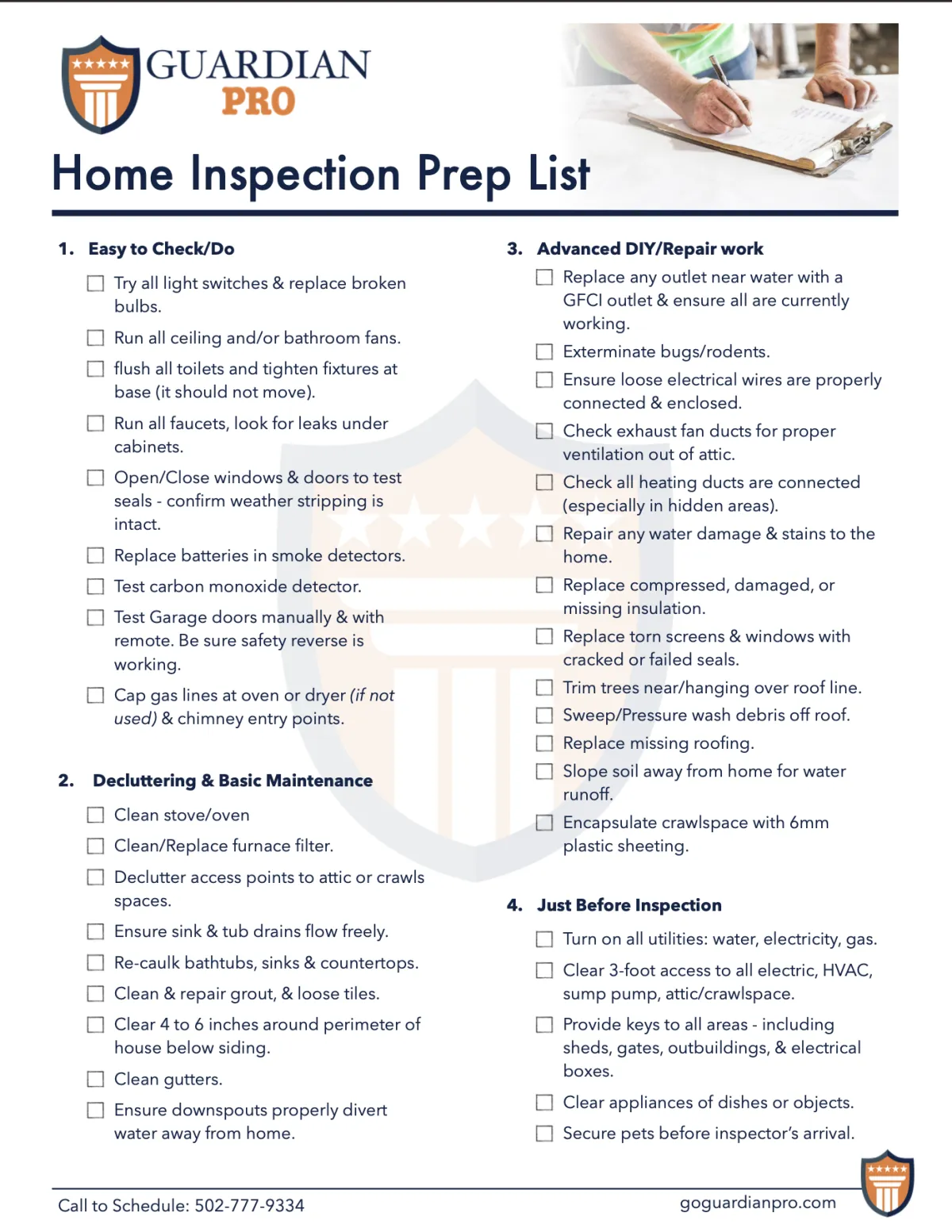
Pre-Inspection Checklist

New Home Owner's Checklist

Useful Measurements Sheet
Got Questions?
Reach Out!
Scheduling
24/7 Online
Click Map to See Our Service Area!
Hover Over Map to See Our Service Area!
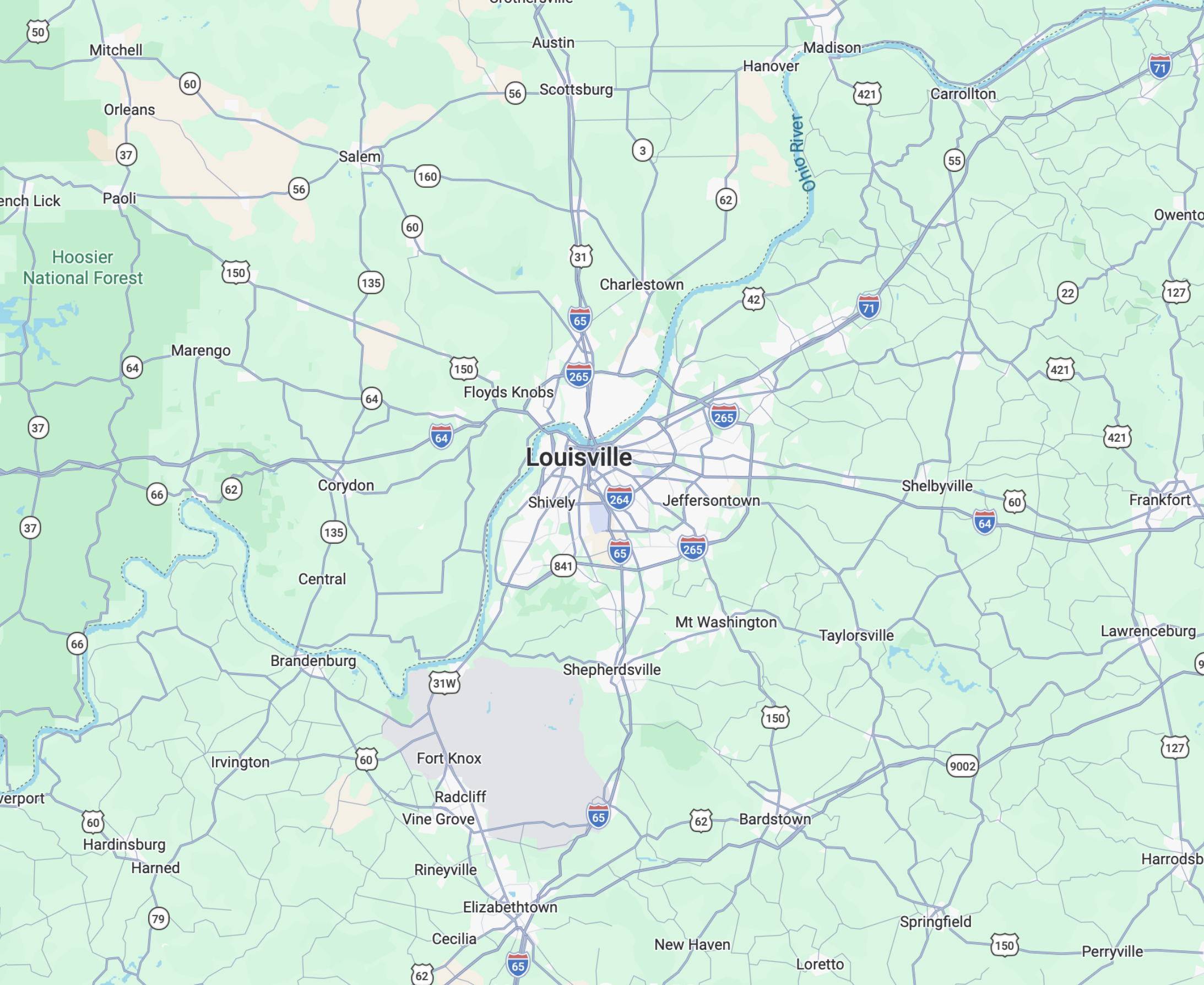
Counties We Service
- Jefferson
- Oldham
- Bullitt
- Spencer
- Hardin
- Shelby
- Nelson
- Taylor
- Trimble
- Jefferson
- Clark
- Floyd
- Scott
- Washington
- Harrison

© Copyright 2026 GuardianPro Inspection, LLC dba Guardian Inspections (KY)
All rights reserved